Many women and AFAB people who are AuDHD (who have both autism and ADHD) go undiagnosed for years. That’s partly because our symptoms don’t always match the common stereotypes. Society and even some psychiatrists still equate autism with little boys that play with trains, and ADHD with hyperactive little boys. Autism and ADHD used to be boys’ diagnoses, because doctors didn’t realize that AuDHD in women is different.
Instead of being loud or disruptive, we might be daydreamy, overly helpful, or simply exhausted. Our symptoms may be concealed by social conditioning, masking, and internalized expectations. We often adapt, mask, or blend in until burnout brings things to the surface later in life.
In this post, we’ll take a closer look at what AuDHD can look like in women, why it’s so often overlooked, and why so many women discover they are AuDHD late in life, often following burnout or their kid’s diagnosis.
Disclaimer: This blog is based on personal experience and is not medical advice. Always consult a qualified healthcare professional before making changes to your health, treatment, or medications.
What is AuDHD
It is estimated that 50-70% of autistic people have ADHD (1), and 30-80% of people with ADHD are also autistic (2). It wasn’t possible to get both an autism and ADHD diagnosis until the change of the DSM (3) in 2013. But today, still, autism and ADHD are often treated separately, and any services are conducted in isolation. Research still focuses on one or the other condition, but not on both as a whole.
ADHD is most often defined as persistent inattention, hyperactivity, and impulsivity, while the symptoms of autism are described as problems in social interaction, communication, repetitive behaviors, and sensory sensitivities.
The diagnostic journey usually begins with one or the other diagnosis, but AuDHD women often don’t feel that just autism or just ADHD describes their symptoms, which may lead to confusion and imposter syndrome. On top of that, autistic and ADHD symptoms can counteract each other, masking each other and making it harder to get a diagnosis. Take, for example, the autistic need for routine and the ADHD struggle to maintain one. Or the ADHD impulsiveness and the autistic need to plan.
This can feel like an endless tug of war in the AuDHD brain. It’s hard to balance two completely opposite needs. The symptoms of autism and ADHD can balance each other, like the autistic need for systems and organisation can compensate for the ADHD disorganisation, but they can also clash – for example, when the chaos caused by ADHD leads to overwhelm of your autistic part. Because of this, AuDHD can have a whole different presentation than just autism or just ADHD.
“My autism creates a need for order, formality, structure, routines, repetition, solitude, and intense interests, all of which are disrupted by my ADHD’s chaotic impulse towards newness, variety, inconsistency, and inattention. So I am forever starting routines and habits (autism), but I can never stick to them because I lose motivation and get bored (ADHD).” – Raising the voices of AuDHD women and girls: exploring the co-occurring conditions of autism and ADHD(4)
Autism and ADHD have historically been considered male conditions. Men were four times more likely to receive a diagnosis than women. Today, this is changing, and women are more likely to seek a diagnosis. But we still face sex biases in diagnostic criteria, long waiting lists, and a lack of pre- and postdiagnosis support.
AuDHD women are often misdiagnosed with borderline personality disorder, bipolar disorder, or obsessive-compulsive disorder. AuDHD can have similar symptoms to these diagnoses. Emotional reactivity, dichotomous thinking, and rejection sensitivity dysphoria are similar to symptoms of BPD, while the tendency to repetitiveness and the need to systematize things may seem like the symptoms of OCD. The symptoms of AuDHD can also be mistaken for anxiety or depression (which is further complicated by the fact that living with undiagnosed AuDHD can lead to anxiety or depression in itself).
Living with undiagnosed AuDHD can lead to mental health struggles, trauma, and internalization of negative messages about one’s character. AuDHDers who are not aware of their diagnosis may feel lazy, too impulsive, too emotional, or socially awkward, often feeling like too much and not enough at the same time.
Symptoms of AuDHD in women
According to Autistic Girls Network (5), symptoms of AuDHD in women can include:
- Often coming up with new routines (and failing to stick to them)
- Impulsively choosing change, and then experiencing anxiety because of the change
- Seeking out new things, but only with familiar people
- Following a familiar process when trying something new
- Experiencing intense hyperfocus or special interests that can often change theme or topic
- Wanting social connection but struggling with social dynamics or needing solitude
- Coming up with new ways of doing the same thing
- Following a particular process when trying something new
- Burning out often, but having problems slowing down
- Having intense anxiety about being late due to time blindness
- Having great long-term memory but poor short-term memory
- Becoming overwhelmed by chaos and mess
Late-diagnosed AuDHD in women
A lot of AuDHD women are late-diagnosed because there wasn’t enough information and resources in their childhood, or simply because autism and ADHD couldn’t be diagnosed together until 2013. The fourth edition of the Diagnostic and Statistical Manual stated that autism and ADHD are mutually exclusive, and only when the fifth edition was released in 2013 were they recognized as co-existing conditions. On top of that, the Diagnostic criteria are skewed towards the male presentation of symptoms. Receiving the AuDHD diagnosis later in life means a delay in getting access to support and resources.
High-functioning AuDHD in adult women
Another cause of late diagnosis can be that AuDHD women are often high-functioning. We are able to work, socialize, and enjoy hobbies in a way that looks neurotypical from the outside. But this disregards how it feels on the inside. It can cost AuDHD women a lot to appear functioning in society. We can achieve it through masking and learned social strategies, but it often comes at the expense of internal stress, emotional sensitivity, executive dysfunction, and sensory overwhelm. The constant emotional stress can cause problems like insomnia, chronic fatigue, muscle pains, and can even lead to burnout.
Female autism and ADHD checklist
When you are an AuDHD woman, you may recognize yourself in this description:
Social Life
- Feeling like you’re always “performing” in public
- Being exhausted after social interaction, even when you enjoyed it
- Copying other people’s social behavior without realizing it
- Oversharing in some conversations and barely speaking in others
- Craving close friendships while simultaneously needing long periods of solitude
- Wanting to socialize but cancelling plans because everything suddenly feels like too much
Everyday Life
- Wanting routines but struggling to stick to them
- Loving novelty while also finding change overwhelming
- Frequently feeling torn between two completely opposite needs
- Feeling like your brain constantly argues with itself
- Starting the day with ambitious plans but struggling to begin
Emotions & Energy
- Feeling emotions intensely and having difficulty calming down
- Becoming overwhelmed more quickly than the people around you
- Alternating between seeking stimulation and desperately needing quiet
- Recovering from busy days much longer than expected
- Experiencing periods of burnout after trying to “keep up” with everyone else
Masking
- Feeling like nobody sees the real you
- Hiding sensory discomfort to appear “normal”
- Spending a lot of mental energy trying to appear relaxed
- Constantly analyzing whether you behaved appropriately after conversations
- Feeling that social interaction is something you perform, not something that comes naturally
Your Inner Experience
- Feeling fundamentally different without knowing why
- Feeling “too much” and “not enough” at the same time
- Thinking ADHD explains part of you, autism explains another part—but neither explains everything on its own
- Feeling like two opposite personalities live in the same brain
- Recognizing yourself in both autism and ADHD descriptions rather than only one
These symptoms of AuDHD in women can often be less noticeable than in men, and the gender stereotypes can mean that they are harder to recognize.
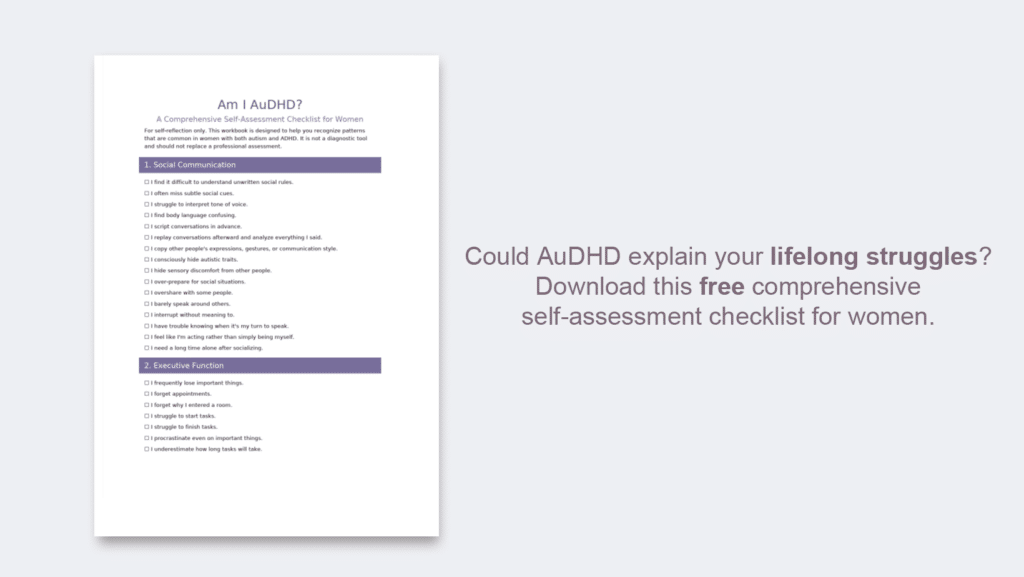
Do you want a more comprehensive list of symptoms? Download a free checklist:
Am I AuDHD? A Comprehensive Self-Assessment Checklist for Women!
How to make life with AuDHD easier
Find a neurodivergent-informed therapist
A good therapist can help you create tailored strategies for your specific needs, find coping mechanisms, and strategies for managing symptoms.
NDTherapists.com is a directory of therapists who are neurodivergent. Most of them are from the United States, but you can find various European countries here as well. You can browse the site by country. A downside is that it isn’t possible to search by therapy approach.
InclusiveTherapists.com – you can search for various therapist styles and focuses. You can find neurodivergent-informed therapists by filtering Therapeutic or healing approaches -> Neurodivergent affirming therapy. You can also filter according to your other needs, such as Somatic Experiencing, EMDR, or trauma-informed therapy.
Build a support system
Educate your family and friends about the symptoms of AuDHD and how they can help you with the challenges it presents. Join a support group for neurodivergent people, if you can find one. It can provide emotional support and a sense of community. Request workplace accommodations if they are available in your country.
Use organizational tools
A common symptom of AuDHD is time blindness. To compensate for that, you need to externalize your sense of time. Use digital calendars for time blocking, apps for visualization of the time, alarms and reminders, and planners. They can help you create a routine that you will be able to maintain, which can relieve a lot of stress and make it easier to manage responsibilities. A great self-care tool is the Finch app, which gamifies daily tasks. An app specifically for AuDHDers is Focus Bear, which includes habit routines, progress tracking, and blocking distractions.
Sensory management
To prevent sensory overload, it’s important to create a sensory-friendly environment. You might benefit from using noise-canceling headphones or self-tinting glasses. Brown noise or pink noise apps can help you calm your nervous system, block out distracting sounds, and create a soothing background that supports focus or rest. Creating a sensory room in your home can also help you regulate your nervous system. Weighted blankets or compression vests can help you with relaxation.
Use sensory diets – scheduled sensory breaks like a midday walk, stretching, or quiet time. Schedule some buffer time between activities so you can re-regulate. Stim openly if you’re in a safe environment—don’t force masking. Wear the same comfy clothes multiple days if that reduces decision fatigue.
Take care of your body
It’s important to have a balanced diet, enough sleep, and exercise. Exercise helps you have more energy, a good diet supports cognitive function, and a good night’s sleep improves focus. Mindfulness, meditation, and relaxation can help you reduce stress and improve mental clarity. It’s also important to make time for things you enjoy, like hobbies, because they contribute to good mental health.
Conclusion
Navigating the world as an AuDHD woman is not easy. Constantly balancing contradictions, masking out of necessity, and finding our own way when the usual paths don’t quite fit. But the more we understand ourselves and connect with others who share similar experiences, the more empowered we become to unmask, reclaim our energy, and live in alignment with who we truly are.
If you’ve seen yourself in these words, know that you’re not alone, and you’re not broken. You’re part of a growing community of brilliant, creative, deeply feeling women who are learning to embrace their neurodivergence and thrive in their own way. Your journey matters. You matter.
Get a free AuDHD guide for late-diagnosed women:
This AuDHD book makes you feel seen:
Read AuDHD Experience, a collection of essays about life with both autism and ADHD!

Sources:
(1) https://pmc.ncbi.nlm.nih.gov/articles/PMC6331660/
(2) https://link.springer.com/article/10.1007/s00787-010-0092-x
(3) https://www.psychiatry.org/psychiatrists/practice/dsm
(4) https://www.tandfonline.com/doi/full/10.1080/09687599.2023.2299342
(5) https://autisticgirlsnetwork.org/audhd/



Helen Olivier is a neurodivergent writer, AuDHD explorer, and professional overthinker with 40+ years of lived experience in the wonderfully weird world of ADHD + autism. She writes for people who’ve been told they’re “too much” or “not enough,” offering comfort, clarity, and the occasional executive dysfunction survival hack. Her blog is her way of turning daily chaos into useful insights for other neurodivergent folks.



2 Comments