AuDHD makes food difficult. When it comes to AuDHD food needs, ADHD craves novelty every time, while autism demands the comfort of the safe few familiar meals. ADHD makes it hard to remember to eat – you may lose yourself in hyperfocus, and time blindness lets meal times slip away unnoticed. Autism creates sensory difficulties. Sometimes we are hungry but none of the food seems appealing, so we simply don’t eat. These ADHD food struggles make ADHD symptoms worse, which makes for even more missed meals. Oh, and are you often hangry, too?
My ADHD side would like a new meal every day at lunchtime, while my autistic side absolutely doesn’t want to cook anything new, ever. I often crave something I don’t have the spoons to prepare, and sometimes go hungry rather than eat spaghetti for the hundredth time. I was happiest, food-wise, in the period of my life when I was ordering takeaway from a vegan restaurant that had a new food on the menu every day. I took to it while I was taking care of my dying best friend, my mousie Daisy, and simply didn’t have the spoons to cook. My ADHD was happy because every day the lunch was a tasty surprise, a dopamine hit. But it wasn’t sustainable financially.
While I struggle with cooking lunch, I eat the same thing for breakfast and dinner every day – a comforting routine. Lunch is my ADHD meal, while breakfast and dinner are my comfortable autistic meals.
Now I’m trying to find 3-5 healthy vegetarian recipes that I can prepare in one pot or pan under 30 minutes, and then cook them on rotation. It’s hard because I very much don’t want to be cooking new recipes. Autism says nope. I have to remind myself that with repetition, new recipes become familiar to cook, that it will be okay. But the hurdle of cooking something new for the first time is real.
In this article, I want to look at some tips and hacks to keep our AuDHD brains fed. Because sometimes ADHD food solutions are simply about eating something, and that’s enough. And a lot of these tips overlap with what actually makes ADHD meal planning work.
This article contains affiliate links. Thank you for your support!
AuDHD-friendly meal planning
Noelle Daoire, in an article Top ADHD-Friendly Meal Prep Tips (1) says that meal planning is hard for our AuDHD brains because it requires a lot of executive function: decision making, planning, prioritizing, shopping, finding the spoons to prepare the meal, and even then, you may need to navigate autistic sensitivity and ADHD time blindness to actually keep yourself fed. This is exactly why many of us struggle with ADHD meal planning in the first place.
According to Daoire, there are plenty of benefits of ADHD meal planning: It reduces overwhelm, saves time, helps you eat healthier, and even reduces the ADHD tax by reducing impulsive decisions.
She explains that an AuDHD-friendly meal plan needs to be quick and easy to follow. Look for meals that:
- You enjoy
- Have a minimal number of steps – under five is ideal
- Use a few ingredients
- And requires minimum cleanup – meals that can be cooked in one pot or pan are ideal
Tip: A slow cooker or Instant Pot can make ADHD meal planning and prep easier..
Little hacks that help your AuDHD brain stay fed:
1. Identify 3-7 safe meals that you enjoy eating.
Write down the ingredients and the recipe. Put it somewhere you can easily see, like on the door of your fridge. Keep the ingredients list in your wallet for easy shopping. Keep the ingredients stocked in your pantry. Every time you need to cook, they are there, so you don’t have to spend a lot of time trying to come up with new ideas about what to make. Safe meals are the backbone of ADHD meal planning.
2. Batch cook.
Whenever I cook, I make enough of the food to last me at least three days. Usually, I cook more portions and freeze some of them. This way, I have a home-cooked, healthy meal ready to go on the days I don’t feel like cooking. Do this several times with different meals, and you will have a variety of frozen meals to choose from when you don’t have the spoons. Batch cooking is one of the most effective ADHD meal planning strategies.
3. Pre-made meals.
When executive function is low, pre-made meals can save the day. I regularly use a box that has pre-prepared ingredients along with the recipe, so I can just follow it step by step. It eases the cognitive overload of shopping and deciding what to cook. I just grab one of the boxes from the shelf in the supermarket and follow the recipe. You can buy pre-washed and pre-cut vegetables or get other ready-to-cook ingredients. This makes ADHD meal planning far more manageable.
4. Visualize.
Use an app for your shopping list and recipes. Use a whiteboard or sticky notes on your fridge door to visually map out the meals for the week. Create index cards listing the ingredients for each meal and take them with you to the grocery store. Visual tools reduce the mental load and are key to ADHD meal planning.
5. Focus on the protein.
Make your meals protein-based. Proteins stabilize your blood sugar, give you sustainable energy, and support dopamine production. Avoid too many artificial ingredients, high amounts of sugar, and artificial flavors, dyes, and sweeteners, as they can make hyperactivity worse. Balanced meals with protein, whole grains, vegetables, and omega-3 fatty acids are ideal ADHD food combinations.
Tip: An easy way to have enough Omega-3 fatty acids in your daily food intake is to add a spoonful of ground flaxseed to your morning oatmeal or yogurt.
6. Make an inventory of foods that you like and dislike.
Then think about what the qualities of those foods are? Can you find more foods with those characteristics that you love? This small step helps make ADHD meal planning feel intuitive.
For example, I love everything crunchy, and because of that, I have added sunflower seeds steeped overnight in water to my morning oatmeal. It’s healthy, and the crunch is satisfying. On the other hand, I hate chewy or slimy structures, so meal stuffs I avoid are, for example, shiitake mushrooms or soy meat.
7. Take note of other factors
What barriers do you struggle around eating? For example, are you too busy to prepare food? How many times a day do you prefer to eat? Do you prefer following a recipe or improvising?
Create meal plans for low, medium, and high energy days. On high-energy days, cook healthy meals and batch-freeze portions for the low-energy days. This is the heart of personalized ADHD meal planning.
8. Building blocks method.
If you are not a person who likes to follow a recipe, but you would still like some structure, assembly, or meals from the following building blocks:
- Base: high fiber carbs (pasta, rice, couscous, bulgur, oats…)
- Protein (meat, eggs, tofu, cheese, tempeh, lentils, chickpeas, beans, hummus, yoghurt…)
- Produce (fruits and vegetables)
- Sauce (salad dressing, pesto, peanut or tahini sauce, guacamole, olive oil with lemon or balsamic vinegar…)
- Toppings (nuts, berries, shredded cheese, seeds – chia, flax, sesame, sunflower, pumpkin, fresh herbs, a drizzle of honey or maple syrup…)
Make a list of ingredients that belong to each building block. Ingredients that you really like, don’t include things you dislike. This turns ADHD food choices into simple mix-and-match options. You can use this list when you go shopping. Keep it handy in your phone.
9. Meal prep
Start the week by cooking several different protein sources for your meals. You can then easily prepare meals around them.
10. Prepare a fruit or veggie snack in advance
Cut some fruits and vegetables and put them in a clear container in the fridge. for a healthy afternoon snack. This way, when you get the munchies, you will already have a healthy, nutritious option at hand.
11. Have a designated snack corner
Keep a section of your fridge, or a designated snack bin, that is stocked with healthy snack options. This will help you keep yourself nourished when the executive dysfunction hits and you don’t have the spoons to prepare a whole meal.
Tip: Always have healthy food on your shopping list and in your home.
12. Choose the right time
Make food decisions in times when you are rested, focused, and not hungry. Take time to plan for the week ahead. Prepare your food when you have the capacity to take on extra tasks. You make healthier decisions when you are not tired and hangry. This simple shift improves ADHD meal planning outcomes dramatically.
13. Breakfast for dinner
When you don’t have the energy to prepare dinner, just make what you usually have for breakfast. Breakfast food like scrambled eggs, overnight oats etc., is nutritious and easy to make.
14. Use the fridge door.
A tip from K.C. Davis, aka @domesticblisters on TikTok, the author of the hook How to Keep House While Drowning: rearrange your fridge so that all produce is in the door where it’s easily visible, while less-used stuff like condiments and other non-perishable stuff is hidden away in the crisper drawer. This helps you to see right away all the food that expires quickly. You are also able to see easily what ingredients are available for cooking.
15. Add a straw to your water bottle.
A surprising trick to help you keep hydrated. It works like a charm for neurodivergent people, making hydration more interesting and therefore easier.
Sources:
(1) https://www.shimmer.care/blog/adhd-friendly-meal-prep
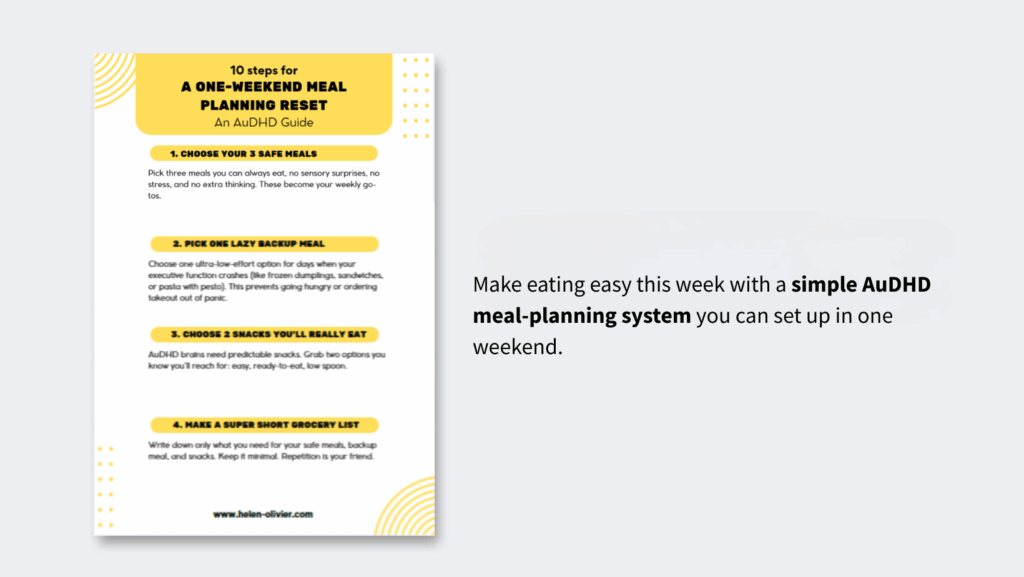
Meal planning made simple
Get my 10 Steps for A One-Weekend Meal Planning Reset: An AuDHD Guide!
Did you find this blog post useful? Support Not Broken and get it (and my other ebooks) at a special price!
Not Broken: Working With Your AuDHD Brain is an ebook packed with practical AuDHD-friendly tips and lifehacks like the ones you’ve just read in this article, all collected in one place to make everyday life a little easier.
My Indiegogo campaign is now live! By backing it, you can help me cover the professional proofreading of Not Broken and get the book, or bundles of my ebooks and courses, at prices I don’t plan to offer again.



Helen Olivier is a neurodivergent writer, AuDHD explorer, and professional overthinker with 40+ years of lived experience in the wonderfully weird world of ADHD + autism. She writes for people who’ve been told they’re “too much” or “not enough,” offering comfort, clarity, and the occasional executive dysfunction survival hack. Her blog is her way of turning daily chaos into useful insights for other neurodivergent folks.