Perhaps you have heard the story about the lady who came on board the tram and demanded that the person sitting in the nearby seat get up and let her have it despite there being ample vacant seats around, because “it’s her usual seat”.
Most people would assume this lady was being outrageous.
But today, I noticed myself being this lady.
Why Small Changes Don’t Always Feel Small
You may have noticed in my other blog posts that I call myself “solar-powered”. And as such, I’m determined to make use of every little scrap of sunlight there is to be had, especially this early in the springtime when it still is a precious commodity after the long winter.
My building is located such that there is sunshine on my balcony in the afternoons, and I use it to the fullest, always spending my time there. But at this time of the year, the shadow of the opposite building covers the sun by 5 o’clock. This means that I pack my stuff and migrate to the bench around the block. I fully expect that the neighbors will soon know me as “the letter lady” because I often use that time to catch up on my pen-paling, if I’m not reading. But, inevitably, even the sunshine there is cut by the building in front. That’s when I make my last move for the day and end up on a bench in front of our apartment complex.
Well, today I arrived there, and both of the benches were taken. This is very unusual and has thrown me completely out of the loop. ‘This is the time of the day that demands me to sit on the bench, how dare they take space on it?’ was my first reaction.
In the end, I threw my jacket on the small grassy hillside next to the benches and sat down. It’s where I’m writing this male zamyšlení. It is an okay replacement, despite the toddler who has come to stare at me a moment ago, drawn by my unusual seating arrangement. (I firmly maintain that toddlers are scary, and you won’t persuade me otherwise.)
But it made me think how often we autistics are so very rigid in our routines and how much energy it takes out of us to work on alternative solutions.
When Emotions Crowd Out Solutions
Years ago, when I was still together with Ben, we went to the Festival of Imagination in Chotěboř, the biggest sci-fi and fantasy convention in our country. But when we arrived there, we found out there had been a mix-up, and they had accommodation for us only from the next night on.
A rational person would start looking for a solution.
My first reaction was to burst into tears. I was overwhelmed by the sudden change of plans, by the problem that had suddenly and unexpectedly arisen.
In the end, Ben booked a hotel for that missing night, a solution that I would surely come to if I had the capacity to think instead of panic.
Every Brain Has a Different Breaking Point
In the first case, I was able to find a solution quickly because the stakes were negligible. It was a small problem, and solving it didn’t require a big mental leap, just a small readjustment. I still got to sit in the sun, I just had to come to terms with a less comfortable place.
This wasn’t true in the second case. Standing at the festival reception desk and suddenly finding out that we had nowhere to sleep that night, I was drowning in big emotions, unable to problem-solve. The disruption of expectations I had about the situation was too big to process quickly.
And maybe that was true for the lady in the tram too. Maybe she was so dead set on that specific seat that the emotional cost of finding a different one was simply too big to consider.
The thing is, everyone has a different bar for such situations. Maybe our capacity to absorb disruptions of our expectations fluctuates, from moment to moment, from person to person. Maybe we shouldn’t frown on someone just because, at a specific time in their life, they are unable to see any other options.
And maybe we shouldn’t be too hard on ourselves if we are the ones who can’t do it.
Finding Plan B Without Beating Yourself Up
And on the other hand, maybe, sometimes our ability to find unexpected solutions is bigger than that of neurotypicals, too. While I was writing this blog post on my phone, the battery died. And so I continued to write it by hand on the back side of two different package receipts, and when I ran out of space on those, I finished it out on a tissue. (With a firm note to my scattered brain self not to blow my nose on it before I get home.) When the emotional stakes are low, our creativity is able to shine through.
So, let’s be kind to ourselves, and when something throws our day out of whack, give ourselves a little grace as we figure out exactly what to do with it.
Want to see more posts like this?
Sign up for my newsletter and get a free copy of the mini-ebook AuDHD Survival Guide: 5 Steps After Your (Self)Diagnosis!
Are you a walking contradiction?
Having an AuDHD brain is a challenge. You fit some criteria for both autism and ADHD, but you don’t find yourself in them, not completely.
In some things, you are the complete opposite of autism. In some ways, you are the complete opposite of ADHD. And you always want two different things at once. You are constantly pulled in two completely opposite directions.
It’s exhausting. And difficult to navigate.
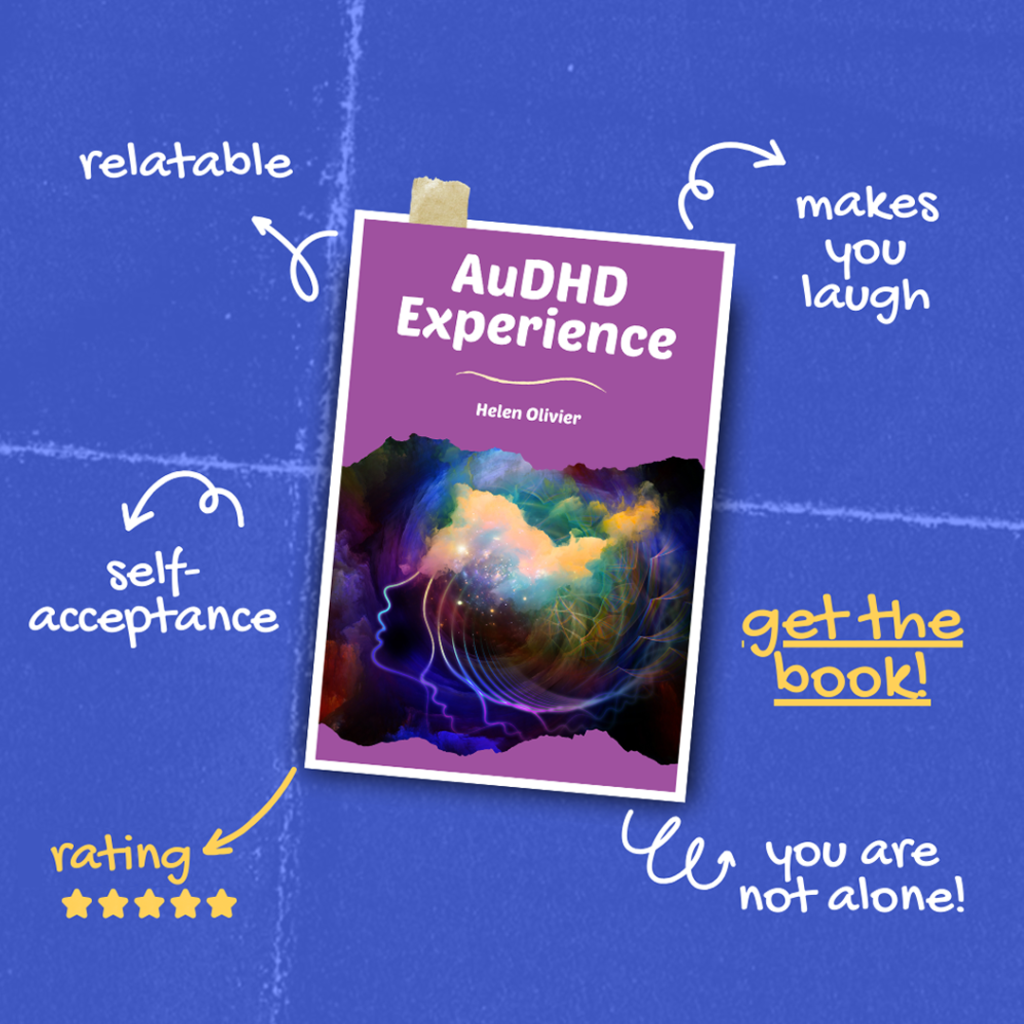
In the ebook AuDHD Experience, I talk about the constant inner conflict. About autistic days and ADHD days. About the AuDHD burnout and why it’s so hard to get out of it. About balancing these two very different sets of needs – and about self-acceptance, despite the odds. If you want to feel that someone gets you, this ebook is just the thing for you. Check it out now!



Helen Olivier is a neurodivergent writer, AuDHD explorer, and professional overthinker with 40+ years of lived experience in the wonderfully weird world of ADHD + autism. She writes for people who’ve been told they’re “too much” or “not enough,” offering comfort, clarity, and the occasional executive dysfunction survival hack. Her blog is her way of turning daily chaos into useful insights for other neurodivergent folks.