Sleep issues affect up to 80% of autistic people (1) and around 75% of those with ADHD. (2) And for those of us who are both? It’s basically a neurodivergent sleep disaster cocktail. Why is that, and what can you do if your brain just won’t shut up and go to sleep?
Disclaimer: This blog is based on personal experience and is not medical advice. Always consult a qualified healthcare professional before making changes to your health, treatment, or medications.
This article contains a few affiliate links. Thank you for your support!
The link between neurodivergent sleep and delayed hormone rhythms
Neurodivergent people often have delayed melatonin production (3), which means that the hormone that helps our bodies to sleep is released later in the day than for neurotypical people. This is called Delayed sleep phase syndrome(4), and it’s the reason why so many of us are night owls.
Also, cortisol release, the hormone that helps us wake up in the morning, is also delayed for people with late-onset ADHD (5)– by 2 hours on average, compared to neurotypical people. That’s why it can be so hard to get out of bed in the morning.
It makes us out of sync with the natural rhythm of day and night, which can complicate our obligations and social life. It’s a vicious cycle: ADHD can cause a lack of sleep, and, in turn, a lack of sleep worsens ADHD symptoms, leading to even bigger neurodivergent sleep problems.
More facts about neurodivergent sleep
Some more facts: Both autistic people and those with ADHD (1) take longer to fall asleep, wake up more frequently in the night, and, on average, spend less time asleep than neurotypical people. These neurodivergent sleep problems tend to increase with age. People with the inattentive type of ADHD usually struggle to fall asleep in the evening, and people with the hyperactive type often experience insomnia. People with the combined type may struggle with both. Autistic people spend 10% less of their sleep cycle in REM sleep than neurotypicals. All of these problems are caused by specific mutated genes.
People with late-onset ADHD also often have problems with daytime sleepiness. Researchers even speculate (6) that late-onset ADHD could be caused by disrupted sleep patterns. The circadian disruption may act as a stressor that triggers the underlying ADHD traits in those who have a genetic predisposition. Coincidentally, some evidence suggests that the regions of the world with the most sunlight also have the lowest ADHD rates.
We usually need more sleep than neurotypical people to make up for all those neurodivergent sleep complications. When we don’t have enough sleep, we may struggle with daytime sleepiness and impaired functioning.
But sleep doesn’t come easily to us. What to do?
What can help with neurodivergent sleep issues?
Bright light therapy
One thing that can help with delayed sleep phase syndrome is bright light therapy. You sit in front of a daylight therapy lamp (also called a light therapy lamp or SAD lamp – see tips on how to choose one in this blog post) within 30–60 minutes of waking up. The lamp should be placed about 16–24 inches (40–60 cm) from your face, at eye level or slightly above, at about a 45-degree angle so the light reaches your eyes indirectly. The recommended duration of the bright light therapy is 20–30 minutes per day. In the beginning, it may cause a mild headache that will pass with repeated treatment. You can start with 10–15 minutes and increase the time gradually if you’re sensitive. During the therapy, you can read, eat breakfast, work, or scroll your phone—just don’t look directly at the light.
Tip: Make sure that the lamp is 10,000 lux. Also, avoid using it late in the day if you don’t want to stay up.
Exposure to bright light in the morning suppresses melatonin production, which means you will feel more awake. (It can also help increase serotonin levels in the brain, which helps with seasonal affective disorder, but that’s another story.) The bright light therapy can even help your ADHD – research shows (7) that low light exposure can worsen ADHD symptoms.
Melatonin
Another thing that can be helpful is treatment with a low dose of melatonin (1-3 mg) (8), taken 1-2 hours before you want to fall asleep. I use it and can confirm that it’s very effective for falling asleep quickly. Be careful about taking high doses, though – they may actually make things worse. For some people, melatonin can cause nightmares (for me, in the beginning, it did), so it’s better to be careful and start slow. It’s better to take melatonin only occasionally, because long-term use may interfere with your body’s ability to produce this hormone. You should always consult the use of melatonin with your doctor.
Tip: You can get a melatonin tablet that dissolves in the mouth and has a higher absorption rate.
Other supplements
Other supplements (9) that can help with better sleep are:
- Magnesium glycinate
- Glycine
- L-theanine
- Valerian
- Passionflower
Neurodivergent sleep tips
So, what can you actually do to make your sleep better? Here are some practical, neurodivergent-friendly sleep tips that go beyond “just turn off screens before bed”—because if it were that easy, you wouldn’t be here.
1. No caffeine after 15 PM
Caffeine can delay melatonin release.
2. Schedule a time for your interests during the day
This way, you won’t get distracted by them before bed.
3. Set a wind-down alarm
Set a phone reminder to ring 60-90 minutes before bedtime to help you slowly transition into a calming routine.
4. Use a “buffer zone” instead of a strict bedtime routine
Instead of saying “I will go to sleep at 10 PM, try creating a 1-hour wind-down zone between 9-10 PM.
5. Create an interest-based bedtime routine/buffer zone
ADHD brains respond better to things that interest us. Try a low-stimulation, soothing activity you enjoy, like reading a good book, listening to your favorite podcast, or playing a mobile game you like.
6. Try a warm bath or shower 1-2 hours before bed.
When your body temperature lowers after the shower or bath, your body takes it as a cue to get asleep.
7. Use blue light filters several hours before bedtime
Use a filter app like f.lux in the hours before bedtime to protect yourself from blue light that can keep you awake.
8. Do an evening braindump
ADHD brains can be full of racing thoughts even as you want to sleep. Write down your thoughts, feelings, and ideas you may get hooked on before going to sleep. Keep a notepad beside your bed in case you wake up with an idea you need to jot down.
9. Adjust your sleeping environment to meet your sensory needs best
Set a comfortable temperature, choose soft bedding with a texture you like, listen to white or green noise, and use a weighted blanket to provide deep pressure. Make your room dark or wear an eyemask. Make sure everything smells good.
10. Don’t lie in bed if you can’t sleep.
If you can’t sleep after half an hour, get up and do a low-stimulation activity in a dim light. Return to bed only when you start getting sleepy. Lying in bed awake can make your brain associate bedtime with anxiety.
11. Keep a consistent wake-up time
Set your alarm to the same hour every day, even on weekends. This will help stabilize your circadian rhythm more than anything.
12. Schedule something you enjoy first thing in the morning
To avoid procrastinating getting out of bed in the morning, plan an enjoyable activity you can look forward to.
13. Keep a sleep diary
It will help you understand what supports your sleep and what disturbs it.
If you’ve been feeling like your brain just doesn’t come with an “off” switch at night, you’re not alone. For those of us with autism, ADHD, or both, sleep can feel like a nightly battle we didn’t sign up for. But here’s the thing: it’s not your fault. Your brain is wired differently, and that includes how it handles sleep.
So be gentle with yourself. Experiment. Keep a sleep diary. Try a few of the strategies mentioned here and see what fits. You deserve rest. Not just because it’s good for your health, but because functioning in a world not built for your brain is exhausting. Give yourself the grace to find what works for you.
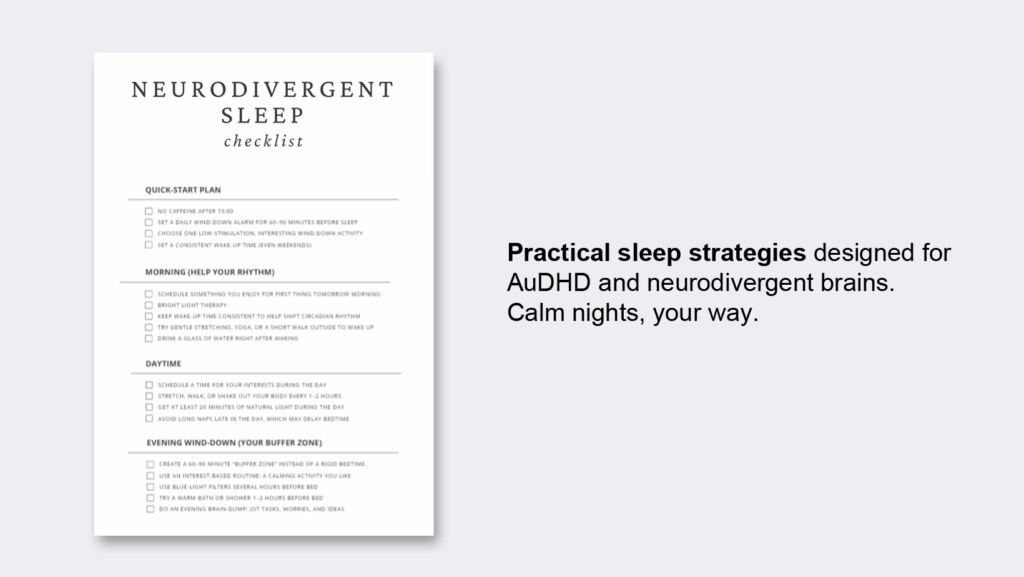
Want a simple way to put these tips into practice?
Download my free Neurodivergent Sleep Checklist here:
Sources:
(1) https://neurodivergentinsights.com/autism-and-sleep/
(2) https://www.sciencedaily.com/releases/2017/09/170904093443.htm
(3) https://www.sciencedirect.com/science/article/abs/pii/S0149763409001833
(4) https://www.mayoclinic.org/diseases-conditions/delayed-sleep-phase/symptoms-causes/syc-20353340
(5) https://pmc.ncbi.nlm.nih.gov/articles/PMC6487490/
(6) https://pmc.ncbi.nlm.nih.gov/articles/PMC6487490/
(7) Kooij, S. “Circadian rhythm and sleep in ADHD–cause or life style factor?.” European Neuropsychopharmacology 27 (2017): S535.
(8) https://www.sleepfoundation.org/melatonin/melatonin-dosage-how-much-should-you-take
(9) https://chandramd.com/best-natural-sleep-aids/


Helen Olivier is a neurodivergent writer, AuDHD explorer, and professional overthinker with 40+ years of lived experience in the wonderfully weird world of ADHD + autism. She writes for people who’ve been told they’re “too much” or “not enough,” offering comfort, clarity, and the occasional executive dysfunction survival hack. Her blog is her way of turning daily chaos into useful insights for other neurodivergent folks.
This blog is based on personal experience and is not medical advice. Always consult a qualified healthcare professional before making changes to your health, treatment, or medications.